on the óresteia
Interview with Benedict Andrews
by Melkorka Gunborg Briansdóttir
Why were you drawn to the Oresteia?
I first fell in love with the violent poetry of the Oresteia when I read the Ted Hughes version in the late 90s. Since then it’s always been sitting behind me, waiting.
During COVID there was a sudden void — the real possibility that theatre might not happen again. In that moment of rupture, something clarified for me: if I was going to return at all, it had to be to the Greeks. After losing theatre, I needed to go back to its source, the deepest well, the bedrock. The Oresteia is the skeleton buried underneath the house of Western theatre.
The Oresteia interrogates the moment where theatre moves from ritual sacrifice into drama. It’s where theatre becomes a tribunal, a place to ask what justice is and what a society should be. It’s also where theatre discovers the split subject. In Aeschylus, each character is fundamentally split in two, as if by an axe. Theatre moves from the act of sacrifice into the act of questioning that sacrifice. Ritual purgation begins to give way to emotional catharsis — to a kind of radical empathy. This is the very foundation of theatre.
The Oresteia’s themes are particularly relevant now, in its dealing with cycles of violence, and the trauma and aftermath of war.
At the root of the trilogy is the idea of corrupt sacrifice and violated ceremony. The sacrifice of Iphigenia on the shore at Aulis echoes through the plays, as does the murder of the children of Thyestes by his brother Atreus a generation earlier. In both instances, the violence involves a profound betrayal of trust: between brothers, between guest and host, between father and daughter. That breach of trust festers like an open wound at the core of the plays.
It breeds further violations — Clytemnestra’s deceitful welcome that ensnares Agamemnon, the sham theatre Orestes stages to gain entry to the house and murder his mother. Violence disguises itself as ceremony; killing masquerades as justice. This is one reason the plays speak so urgently to our present moment. We live in a time when lies routinely pass as truth, when public rituals — political, legal, even humanitarian — feel hollowed out, and when the bonds that hold civil life together seem increasingly fragile. Like the world of the Oresteia, ours is haunted by broken promises and corrupted ceremonies, and by the fear that once trust collapses, violence may become the only language left.
In the Oresteia, violence doesn’t erupt once and end. It repeats, mutates, is handed down. Trauma is inherited inside the family and then formalised inside the state, and the state in turn feeds it back into the family. Each attempt to restore order creates the conditions for the next catastrophe. The trilogy asks whether violence can ever truly be resolved, or whether it is simply displaced and rebranded as justice, law, or necessity.
These plays are the first great reckoning with justice, the moment a civilisation tries to climb out of the cycle of revenge and invent law, language and democracy. But Aeschylus already saw the fault line. Every new order is built on the ruins of the old. Every system of justice carries the ghost of the crime it claims to erase. The trilogy asks whether violence can ever truly be resolved, or whether it is simply displaced and rebranded as justice, law, or necessity.
We’re living through another age of reckoning. Our world, like theirs, is cracked by war, patriarchy, ecological collapse, state violence and private rage. We watch distant violence unfold daily, often passively, always mediated. The gods may be gone, but judgment hasn’t disappeared. It’s simply become colder, more procedural. The algorithm now decides what is seen, what is forgotten, what
counts. We do these plays now because the world has circled back to the same moral edge — between vengeance and forgiveness, between memory and forgetting, between ruin and renewal. And because theatre, like democracy, only exists in the act of gathering, to look together at what we’ve done and ask what kind of world we build next.
Why did you decide to write your own version of the trilogy? In that process, what felt important to preserve and what did you want to rethink or liberate?
Theatre is always an act of translation. The text is unstable, a living thing. As both writer and director, I’m always trying to translate a text into the present tense, to bring it kicking and screaming into the now. In this case, the body we’re unearthing comes from the very origin of Western theatre. The question isn’t how to preserve it, but what still speaks, what wounds are still open, what mysteries remain unresolved. Why do these damaged figures — Clytemnestra, Orestes, Electra — insist on returning?
Writing my own version is also a way of asking: what if this were a new play, written today? I’m not interested in museum theatre — not simply because of an aversion to so-called period detail or historical reconstruction, but because of what happens when form hardens. When a work is treated as settled or definitive, it loses its danger and volatility. The violence becomes aesthetic rather than active, something to admire rather than something that can still disturb or unsettle. I’m interested in whether these texts can still do real work on us, rather than being safely contained.
At the same time, I refuse to domesticate the Oresteia. These myths drag the strangeness and violence of the past with them; that’s part of their power. Some contemporary adaptations flatten that strangeness, turning the material into something recognisable and psychologically tidy. I want to preserve the sense that something ancient, irrational and dangerous is still operating underneath the surface. I’m after a dynamic, performative language — a poetry in motion — that stays close to Aeschylus’s dense, incandescent, incantatory, ritualistic charge, while remaining wholly original on its own terms.
As I write, I’m also defining the logic of the staging. The text is already proposing how it wants to be embodied. The decision to reduce the trilogy to an ensemble of five was made on the page. It isn’t merely a gesture of economy, but a statement about where the myth now lives.
In Aeschylus, the chorus, the house, the city, the gods and the dead are vast external forces. Here, they’re compressed into five living bodies. The chorus doesn’t disappear so much as move inside the performers. Each actor carries multiple voices — parent, child, god, citizen, ghost — flickering between them. The boundaries between role and self begin to collapse, and the myth stops feeling like distant narrative and starts to feel like something unfolding inside a single nervous system.
Archetypes overlap, creating friction and energy. Characters sit inside other characters; faces peel away. Cassandra is nested inside Electra. Identities mutate and transform, just as the people we love — the people who haunt us — return with new faces in our dreams.
In a post-Freudian world, the House of Atreus is a palace and a psychic architecture. What Aeschylus externalised as divine law, we now experience as inner law: guilt, compulsion, repression. Orestes doesn’t need Apollo to command him, because the command already lives inside him. The Furies are no longer creatures of the underworld; they function as the unconscious breaking through reason’s defences. Working with five actors allows the audience to experience the myth at a human scale — intimate, volatile and unresolved — where guilt and innocence can no longer be cleanly assigned.
You have described the Oresteia as a spoken poem and during rehearsals placed particular emphasis on the act of speaking and the relationship between thought and speech. What does that mean for this production?
Language in these plays behaves like a jagged thought in motion. Once the characters start speaking, they’re overtaken by it. They’re dragged away by the current; they vomit speech. That has to be suggested on the page through rhythm and structure, not just meaning.
When the language slows down, it’s because something inside the character slows or fractures. When it accelerates, it’s because neurons are firing in the skull, adrenaline flooding the body. We need to feel the chemical reactions behind the speech.
Speaking this play demands a kind of athleticism. It’s like stepping off a cliff. You have to fall through the language and the argument completely, inhabiting its force and pressure without resistance.
You have considerable experience directing in a language that is not your own. While many would think of this as an obstruction, do you feel this also hones your craft?
There’s a line in King Lear where the newly blind Gloucester, asked how he sees the world, replies: “I see it feelingly,” implying understanding not through mastery or distance, but through the body. Losing language can work in a similar way: it removes certainty and forces you to feel your way toward truth rather than naming it.
Working in Icelandic is a bit like seeing through a glass darkly. I know the language now, but imperfectly. If the cadence stumbles, I feel it physically. For me, theatre is always an act of language becoming embodied, of word becoming flesh — what Herbert Blau calls blooded thought. It’s thinking under pressure, where ideas aren’t abstracted or purified but tested in the body: in breath, fatigue, fear, desire, violence, failure. There’s a genuine vulnerability in directing in a language that isn’t my first, but it’s also an invitation to plug directly into the nervous system of the play in an unexpected and immediate way.
How has the intimacy of Kassinn shaped your approach?
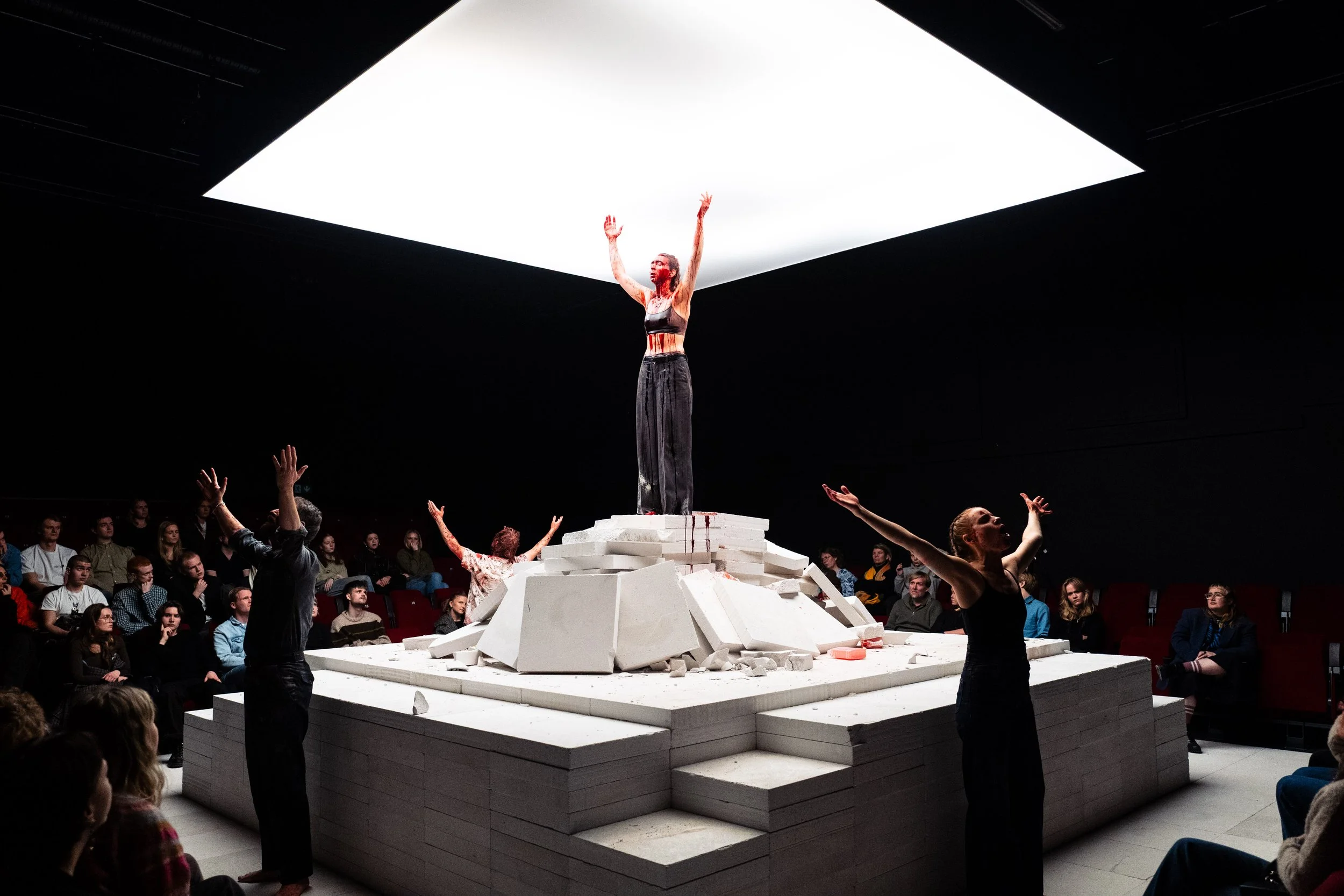
This production places the trilogy’s central questions in a single, brutal space: a slab that functions as altar, tomb, courtroom and ruin. It’s built by the actors’ hands and dismantled by them in realtime. Each block lifted, each liquid spilled records labour and stain. By the end, the theatre itself becomes a wrecked house, a site of inquiry.
Designer, Elín Hansdottír and I wanted the audience to sit around the stage and to be lit by the same ruthless light as the actors. We wanted the audience and the ensemble to share the same space, to breathe the same air. The audience becomes the jury, forced to decide, to take responsibility. The aim was an intense, at times uncomfortable intimacy, where nothing is hidden and everything is exposed. Every prop is a working prop, even the set itself. Everything on stage is material the actors use to play out the ritual of the piece, without trickery or artifice.
The fact that the audience sit on all sides also creates this organic, continuously moving sculpture.
It produces multiple sculptures, in a literal sense, through the way the actors move the concrete blocks of the set, and through the spontaneous, necessary arrangements of dynamic and exhausted bodies. The stage images aren’t fixed or predetermined. They’re made in the moment. They emerge from necessity, from the actors having to carry out these actions. The result is a series of stark, singular compositions that feel ordinary because they’re simply happening in front of you, yet at the same time you’re aware of the small miracle of how they come into being without being pre- planned. Where people stand matters less than why they’re moving — what’s happening inside them or between them. The volatile inner life of a play is its drives, its action. The positioning of bodies and objects may look completely choreographed, but it remains radically open, able to shift from night to night — like iron filings agitated by a magnet.
Why do you keep coming back to the theatre?
In the end, even if I step away to direct a film or an opera, theatre remains my spiritual home. It has a beautiful poverty to it. Nothing is required beyond an actor, a text and a witness. It’s a place of genuine communion, and one of the few remaining spaces where we can step away from screens and the constant bombardment of images. In our mediated age, theatre must remain naive, fragile, utterly ephemeral and utterly human.
This brings us to something fundamental about theatre itself. In Hamlet, Horatio asks, “What, has this thing appear’d again to-night?” Theatre is the place where the body of the play has to returnnightly, like a haunting, an act of possession. The actor has to resurrect Electra each night, bring her back kicking and screaming as if for the first time.
This task of nightly resurrection is glorious, strange and mysterious. I love being present to witness the actors’ act of becoming. I’m in awe of their audacity, their openness, the risks they take, the way they lay themselves bare on our behalf. They put themselves on the line nightly so that we, in the suspended instant of the theatre, might come into deeper intimacy with ourselves.
That idea of return is already present at the beginning of the Oresteia, at the very dawn of Western theatre, when a man stares into the darkness waiting for a distant signal of light. Like him, we sit in the theatre waiting for a spark — of truth, of emotion, of something spiritual or metaphysical. We keep coming back because when that spark arrives, there’s nothing else like it.
I’m still chasing that watchman’s flame — that rare sense of transcendence when the metaphysical plane of a play opens up while remaining raw, concrete and human, when my nervous system tingles with not quite knowing what I’m seeing but feeling I’ve known it forever. We are all the watchman, waiting for illumination.